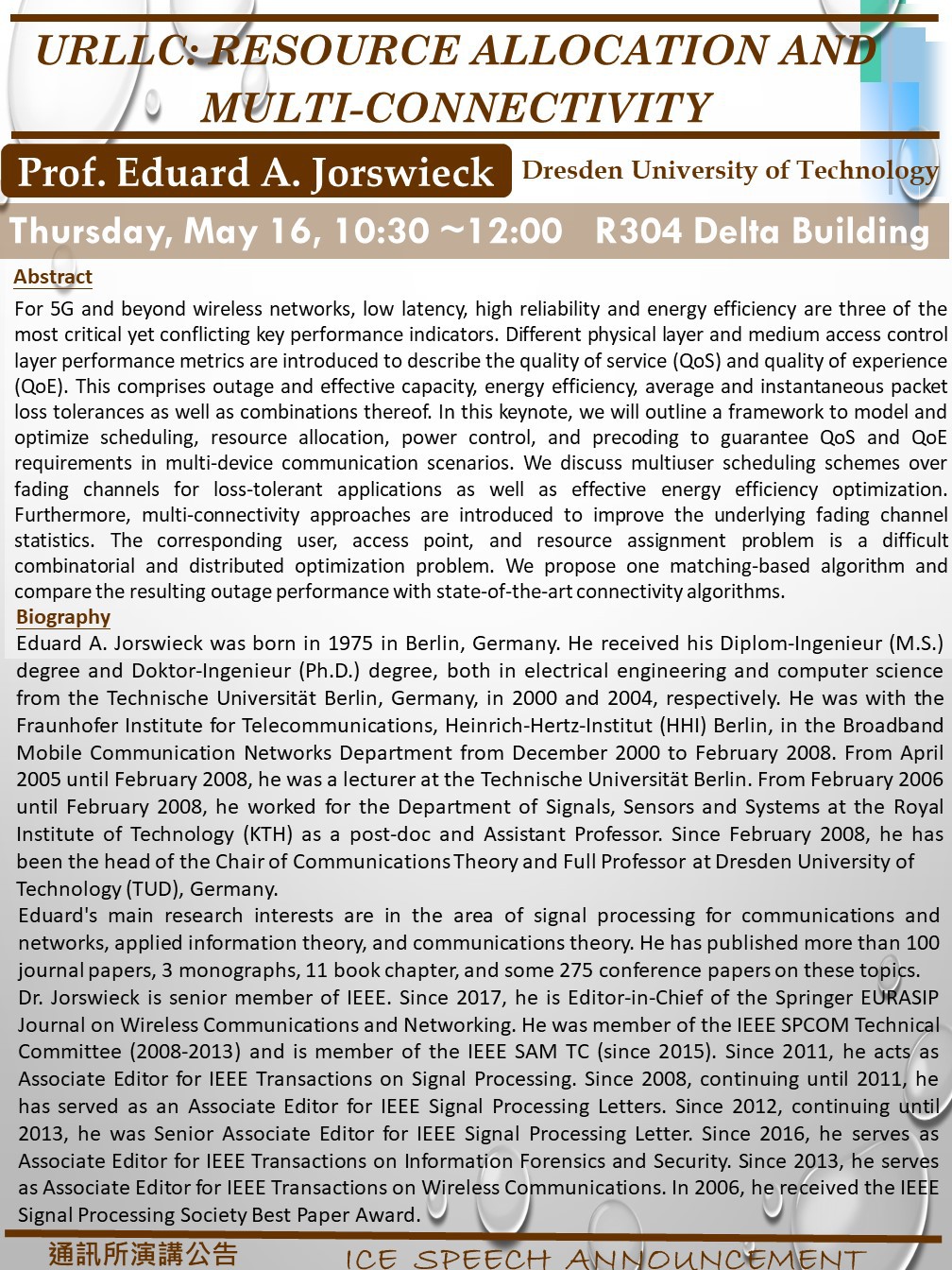
演講題目:URLLC: Resource Allocation and Multi-Connectivity
演 講 者:Prof. Eduard A. Jorswieck, Dresden University of Technology
時 間:2019年5月16日(星期四)10:30
地 點:清華大學台達館 304室
ABSTRACT
For 5G and beyond wireless networks, low latency, high reliability and energy efficiency are three of the most critical yet conflicting key performance indicators. Different physical layer and medium access control layer performance metrics are introduced to describe the quality of service (QoS) and quality of experience (QoE). This comprises outage and effective capacity, energy efficiency, average and instantaneous packet loss tolerances as well as combinations thereof. In this keynote, we will outline a framework to model and optimize scheduling, resource allocation, power control, and precoding to guarantee QoS and QoE requirements in multi-device communication scenarios. We discuss multiuser scheduling schemes over fading channels for loss-tolerant applications as well as effective energy efficiency optimization. Furthermore, multi-connectivity approaches are introduced to improve the underlying fading channel statistics. The corresponding user, access point, and resource assignment problem is a difficult combinatorial and distributed optimization problem. We propose one matching-based algorithm and compare the resulting outage performance with state-of-the-art connectivity algorithms.
The talk is based on:
[1] M. Butt, E. Jorswieck and A. Mohamed, "Energy and Bursty Packet Loss Tradeoff Over Fading Channels: A System-Level Model", IEEE Systems Journal, vol. 12, no.1, pp. 527-538, March 2018.
[2] M. Simsek, T. Hößler, E. Jorswieck, H. Klessig, "Multi-Connectivity in Multi-Cellular, Multi-User Systems: A Matching-Based Approach", Proc. of IEEE, vol. 107, no. 2, pp.394-413, Feb. 2019.
BIOGRAPHY
Eduard A. Jorswieck was born in 1975 in Berlin, Germany. He received his Diplom-Ingenieur (M.S.) degree and Doktor-Ingenieur (Ph.D.) degree, both in electrical engineering and computer science from the Technische Universität Berlin, Germany, in 2000 and 2004, respectively. He was with the Fraunhofer Institute for Telecommunications, Heinrich-Hertz-Institut (HHI) Berlin, in the Broadband Mobile Communication Networks Department from December 2000 to February 2008. From April 2005 until February 2008, he was a lecturer at the Technische Universität Berlin. From February 2006 until February 2008, he worked for the Department of Signals, Sensors and Systems at the Royal Institute of Technology (KTH) as a post-doc and Assistant Professor. Since February 2008, he has been the head of the Chair of Communications Theory and Full Professor at Dresden University of Technology (TUD), Germany.
Eduard's main research interests are in the area of signal processing for communications and networks, applied information theory, and communications theory. He has published more than 100 journal papers, 3 monographs, 11 book chapter, and some 275 conference papers on these topics.
Dr. Jorswieck is senior member of IEEE. Since 2017, he is Editor-in-Chief of the Springer EURASIP Journal on Wireless Communications and Networking. He was member of the IEEE SPCOM Technical Committee (2008-2013) and is member of the IEEE SAM TC (since 2015). Since 2011, he acts as Associate Editor for IEEE Transactions on Signal Processing. Since 2008, continuing until 2011, he has served as an Associate Editor for IEEE Signal Processing Letters. Since 2012, continuing until 2013, he was Senior Associate Editor for IEEE Signal Processing Letter. Since 2016, he serves as Associate Editor for IEEE Transactions on Information Forensics and Security. Since 2013, he serves as Associate Editor for IEEE Transactions on Wireless Communications. In 2006, he received the IEEE Signal Processing Society Best Paper Award.