
Brief Description of Research:
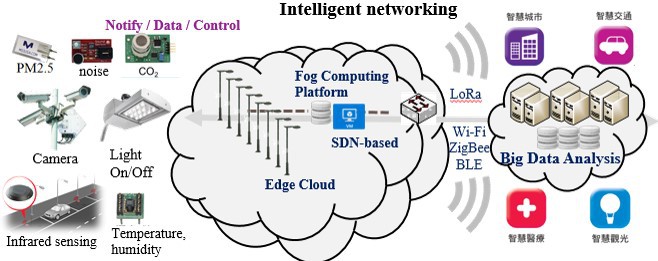
In recent years, there is a rapid growth in the internet of things and intelligent devices due to the substantial
increase in the amount of information. As a result, the intelligent networking technology with edge computing
can provide more reliable and fast transmission capability. The future research direction of this research group
is as follows: Internet of things and applications, big data analysis, fog computing and edge computing, mobile
computing, wireless networks, and UAV networking.
Faculty members in the IOT group:
*Prof. Jang-Ping Sheu、Prof. Wen-Tsuen Chen、Prof. Nen-Fu Huang、Prof. Hwa-Chun Lin、
Prof. Ching-Te Chiu、Prof. Ming-Jer Tsai、Prof. Shun-Ren Yang、Prof. Jung-Chun Kao、
Prof. Yao-Win (Peter) Hong
( *:Coordinator)
Projects:
1. Project Name:On-Campus Blockchain Micropayment System
Project Members:Prof. Chih-Hao Huang、Prof. Shun-Ren Yang、Prof. Jung-Chun Kao、
Prof. Chin-Yu Huang
Project Period:October 2017 ~ September 2020
2. Project Name:Intelligent Life and Environments: Using Smart Bike as the Platform of Wearable Applications
Project Members:Prof. Jang-Ping Sheu、Prof. Wen-Tsuen Chen、Prof. Pai H. Chou、
Prof. Cheng-Hsin Hsu、Prof. Hung-Kuo Chu、Prof. Shan-Hung Wu、
Prof. Hao-Chuan Wang、Prof. Chih-Yung Chang (YKU)
Project Period:September 2014~August 2018
3. Project Name:SDN-enabled Cloud-based Wireless/Broadband Network Technologies & Services
Project Members:Prof. Jang-Ping Sheu、Prof. Wen-Tsuen Chen、Prof. Nen-Fu Huang、
Prof. Ming-Jer Tsai、Prof. Cheng-Hsin Hsu、Prof. Yang, De-Nian(sinica)、
Prof. Ching-Ju Lin (NCTU)
Project Period:September 2014~July 2017
Publications:
1. H. C. Lin and W. Y. Chen, “An Approximation Algorithm for the Maximum-lifetime Data Aggregation Tree
Problem in Wireless Sensor Networks,” IEEE Trans. on Wireless Communications, vol. 16, no. 6, pp. 3787-
3798, June 2017.
2. Jian-Jhih Kuo, Shan-Hsiang Shen, Hong-Yu Kang, De-Nian Yang, Ming-Jer Tsai, and Wen-Tsuen Chen,
“Service Chain Embedding with Maximum Flow in Software Defined Network and Application to the Next-
Generation Cellular Network Architecture, ” IEEE INFOCOM 2017, Atlanta, GA, USA, May 2017.
3. G.-L. Chiou, S.-R. Yang, and W.-T. Yen. “On Trajectory-Based I2V Group Message Delivery over Vehicular
Ad Hoc Networks,” IEEE Transactions on Vehicular Technology, Vol. 65, No. 9, pp. 7389-7402, September
2016.
4. Y.-W. Peter Hong, Teng-Cheng Hsu, and Pradeep Chennakesavula, “Wireless Power Transfer for Distributed
Estimation in Wireless Passive Sensor Networks,” IEEE Transactions on Signal Processing, Vol. 64, No.
20, pp. 5382-5395, October 2016.
5. J.-P. Sheu, C.-W. Su, and G.-Y. Chang, “Asynchronous Quorum-based Channel Hopping Schemes for
Cognitive Radio Networks," IEEE Transactions on Communications, Vol. 64, No. 3, pp. 918-930, March, 2016.
6. J.-P. Sheu and Y.-C. Chou, “Wildcard Rules Caching and Cache Replacement Algorithms in Software-Defined
Networking,” IEEE Transactions on Network and Service Management, Vol. 13, No. 1, pp. 19-29, March,
2016.
7. Tung-Wei Kuo, Kate Ching-Ju Lin,and Ming-Jer Tsai, “Maximizing submodular set function with connectivity
constraint: Theory and application to networks,” IEEE/ACM Transactions on Networking, vol. 23, no. 2, pp.
533-546, 2015.
8. C.-C. Kao, S.-R. Yang*, and H.-C. Chen. “On Energy Efficiency of IEEE 802.16m Interframe Scheduling for
Scalable Video Multicast,” IEEE Transactions on Mobile Computing, Vol. 13, No. 12, pp. 2870-2887,
December 2014.
9. H. C. Lin and H. M. Yang, “An Approximation Algorithm for Constructing Degree-Dependent Node-Weighted
Multicast Trees,” IEEE Trans. on Parallel and Distributed Systems, vol. 25, no. 8, pp. 1976-1985, Aug. 2014.
10. Jung-Chun Kao, “Performance Analysis of Relay-Assisted Network-Coding ARQ with Space-Time
Cooperation in Wireless Relay Networks,” IEEE Transactions on Wireless Communications, vol. 13, no. 8,
pp. 4132-4145, Aug. 2014.