
Date & Time:
2023 / 10 / 20 (Fri) 14:20 - 16:20
Location:
Delta Building R216, NTHU
Speaker:
賴青沂 教授
國立陽明交通大學
Topic:
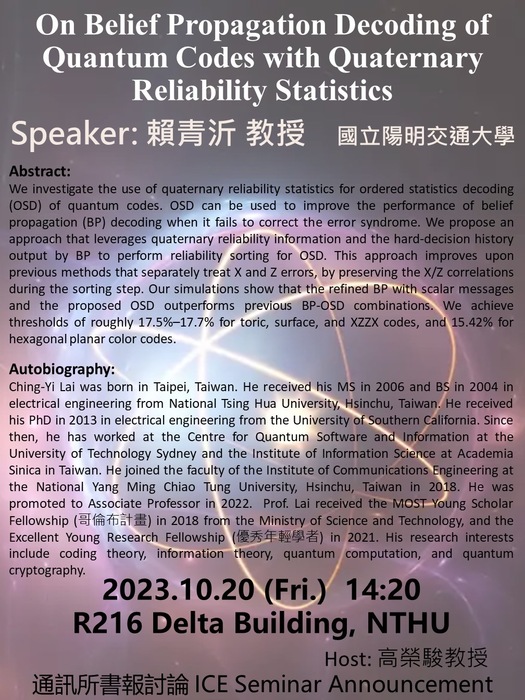
On Belief Propagation Decoding of Quantum Codes with Quaternary Reliability Statistics
Abstract:
We investigate the use of quaternary reliability statistics for ordered statistics decoding (OSD) of quantum codes. OSD can be used to improve the performance of belief propagation (BP) decoding when it fails to correct the error syndrome. We propose an approach that leverages quaternary reliability information and the hard-decision history output by BP to perform reliability sorting for OSD. This approach improves upon previous methods that separately treat X and Z errors, by preserving the X/Z correlations during the sorting step. Our simulations show that the refined BP with scalar messages and the proposed OSD outperforms previous BP-OSD combinations. We achieve thresholds of roughly 17.5%–17.7% for toric, surface, and XZZX codes, and 15.42% for hexagonal planar color codes.
Biography:
Ching-Yi Lai was born in Taipei, Taiwan. He received his MS in 2006 and BS in 2004 in electrical engineering from National Tsing Hua University, Hsinchu, Taiwan. He received his PhD in 2013 in electrical engineering from the University of Southern California. Since then, he has worked at the Centre for Quantum Software and Information at the University of Technology Sydney and the Institute of Information Science at Academia Sinica in Taiwan. He joined the faculty of the Institute of Communications Engineering at the National Yang Ming Chiao Tung University, Hsinchu, Taiwan in 2018. He was promoted to Associate Professor in 2022. Prof. Lai received the MOST Young Scholar Fellowship (哥倫布計畫) in 2018 from the Ministry of Science and Technology, and the Excellent Young Research Fellowship (優秀年輕學者) in 2021. His research interests include coding theory, information theory, quantum computation, and quantum cryptography.
<