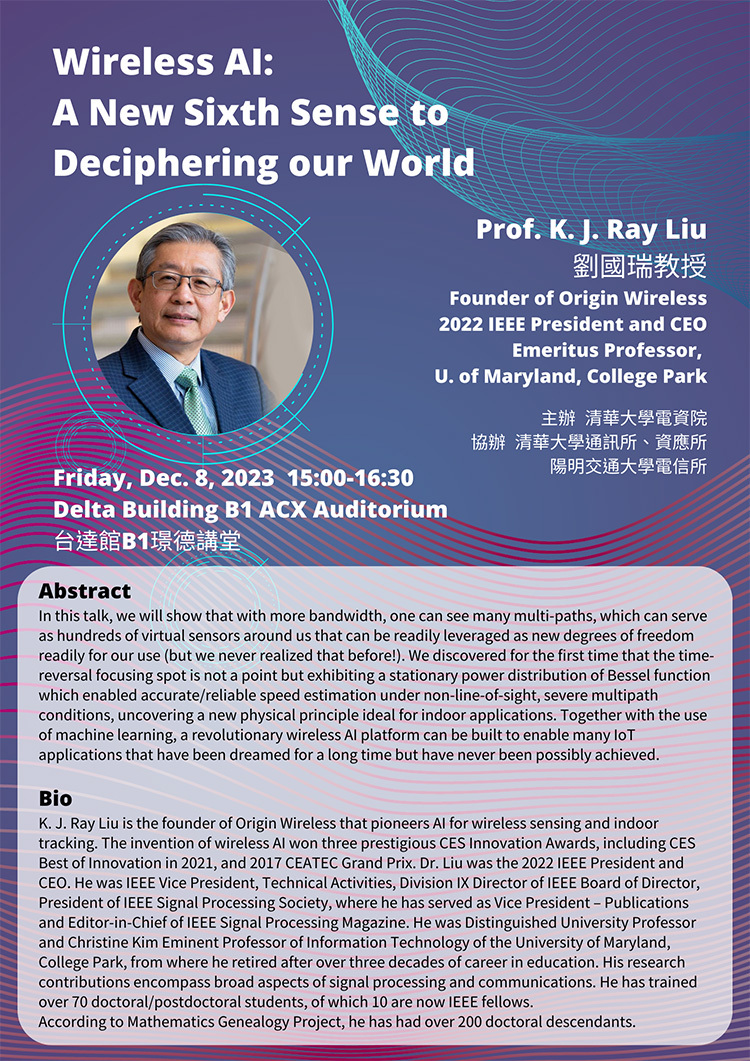
Speaker: K. J. Ray Liu
Founder of Origin Wireless
2022 IEEE President and CEO
Emeritus Professor, University of Maryland, College Park
Title: Wireless AI: A New Sixth Sense to Deciphering our World
Date: 2023/12/8, Friday 15:00~16:30
Location: Delta Building B1 ACX Auditorium, NTHU(台達館B1璟德講堂)
Abstract: In this talk, we will show that with more bandwidth, one can see many multi-paths, which can serve as hundreds of virtual sensors around us that can be readily leveraged as new degrees of freedom readily for our use (but we never realized that before!). We discovered for the first time that the time-reversal focusing spot is not a point but exhibiting a stationary power distribution of Bessel function which enabled accurate/reliable speed estimation under non-line-of-sight, severe multipath conditions, uncovering a new physical principle ideal for indoor applications. Together with the use of machine learning, a revolutionary wireless AI platform can be built to enable many IoT applications that have been dreamed for a long time but have never been possibly achieved.
Bio: K. J. Ray Liu is the founder of Origin Wireless that pioneers AI for wireless sensing and indoor tracking. The invention of wireless AI won three prestigious CES Innovation Awards, including CES Best of Innovation in 2021, and 2017 CEATEC Grand Prix. Dr. Liu was the 2022 IEEE President and CEO. He was IEEE Vice President, Technical Activities, Division IX Director of IEEE Board of Director, President of IEEE Signal Processing Society, where he has served as Vice President – Publications and Editor-in-Chief of IEEE Signal Processing Magazine. He was Distinguished University Professor and Christine Kim Eminent Professor of Information Technology of the University of Maryland, College Park, from where he retired after over three decades of career in education. His research contributions encompass broad aspects of signal processing and communications. He has trained over 70 doctoral/postdoctoral students, of which 10 are now IEEE fellows.
According to Mathematics Genealogy Project, he has had over 200 doctoral descendants.