
Date & Time:
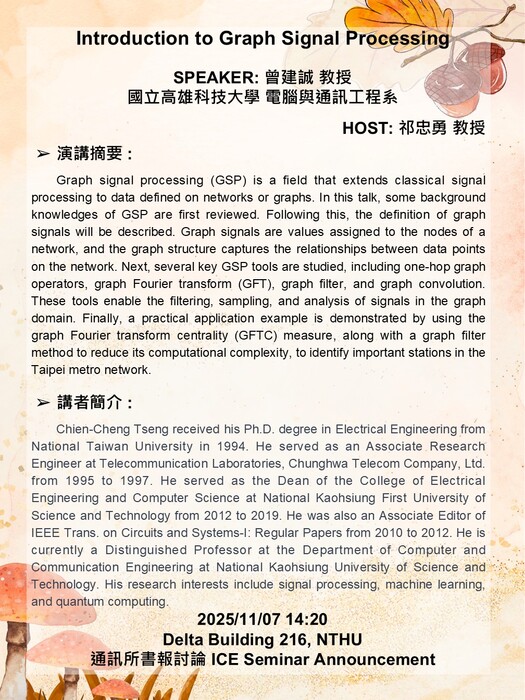
2025 /11 / 07 (Fri) 14:20 - 16:20
Location:
Delta Building R216, NTHU
Speaker:
曾建誠 教授
國立高雄科技大學 電腦與通訊工程系
Topic:
Introduction to Graph Signal Processing
Abstract:
Graph signal processing (GSP) is a field that extends classical signal processing to data defined on networks or graphs. In this talk, some background knowledges of GSP are first reviewed. Following this, the definition of graph signals will be described. Graph signals are values assigned to the nodes of a network, and the graph structure captures the relationships between data points on the network. Next, several key GSP tools are studied, including one-hop graph operators, graph Fourier transform (GFT), graph filter, and graph convolution. These tools enable the filtering, sampling, and analysis of signals in the graph domain. Finally, a practical application example is demonstrated by using the graph Fourier transform centrality (GFTC) measure, along with a graph filter method to reduce its computational complexity, to identify important stations in the Taipei metro network.
Autobiography:
Chien-Cheng Tseng received his Ph.D. degree in Electrical Engineering from National Taiwan University in 1994. He served as an Associate Research Engineer at Telecommunication Laboratories, Chunghwa Telecom Company, Ltd. from 1995 to 1997. He served as the Dean of the College of Electrical Engineering and Computer Science at National Kaohsiung First University of Science and Technology from 2012 to 2019. He was also an Associate Editor of IEEE Trans. on Circuits and Systems-I: Regular Papers from 2010 to 2012. He is currently a Distinguished Professor at the Department of Computer and Communication Engineering at National Kaohsiung University of Science and Technology. His research interests include signal processing, machine learning, and quantum computing.