
Date & Time:
2025 /12 / 05 (Fri) 14:20 - 16:20
Location:
Delta Building R216, NTHU
Speaker:
林家祥 教授
國立成功大學 電機工程學系
Topic:
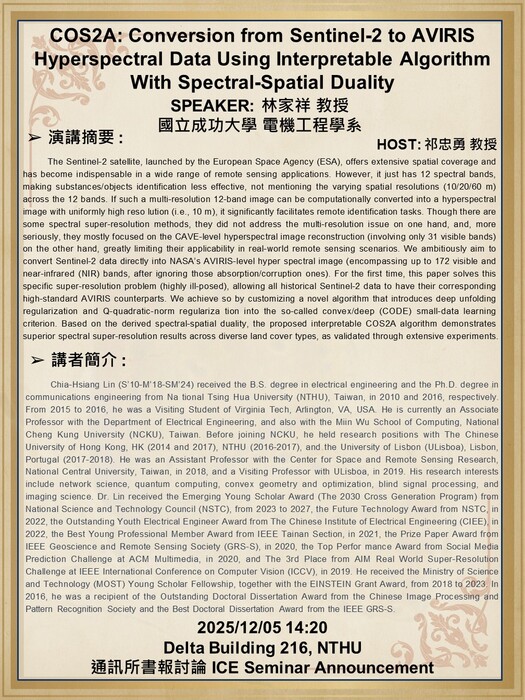
COS2A: Conversion from Sentinel-2 to AVIRIS Hyperspectral Data Using Interpretable Algorithm With Spectral-Spatial Duality
Abstract:
The Sentinel-2 satellite, launched by the European Space Agency (ESA), offers extensive spatial coverage and has become indispensable in a wide range of remote sensing applications. However, it just has 12 spectral bands, making substances/objects identification less effective, not mentioning the varying spatial resolutions (10/20/60 m) across the 12 bands. If such a multi-resolution 12-band image can be computationally converted into a hyperspectral image with uniformly high reso lution (i.e., 10 m), it significantly facilitates remote identification tasks. Though there are some spectral super-resolution methods, they did not address the multi-resolution issue on one hand, and, more seriously, they mostly focused on the CAVE-level hyperspectral image reconstruction (involving only 31 visible bands) on the other hand, greatly limiting their applicability in real-world remote sensing scenarios. We ambitiously aim to convert Sentinel-2 data directly into NASA’s AVIRIS-level hyper spectral image (encompassing up to 172 visible and near-infrared (NIR) bands, after ignoring those absorption/corruption ones). For the first time, this paper solves this specific super-resolution problem (highly ill-posed), allowing all historical Sentinel-2 data to have their corresponding high-standard AVIRIS counterparts. We achieve so by customizing a novel algorithm that introduces deep unfolding regularization and Q-quadratic-norm regulariza tion into the so-called convex/deep (CODE) small-data learning criterion. Based on the derived spectral-spatial duality, the proposed interpretable COS2A algorithm demonstrates superior spectral super-resolution results across diverse land cover types, as validated through extensive experiments.
Autobiography:
Chia-Hsiang Lin (S’10-M’18-SM’24) received the B.S. degree in electrical engineering and the Ph.D. degree in communications engineering from National Tsing Hua University (NTHU), Taiwan, in 2010 and 2016, respectively. From 2015 to 2016, he was a Visiting Student of Virginia Tech, Arlington, VA, USA. He is currently an Associate Professor with the Department of Electrical Engineering, and also with the Miin Wu School of Computing, National Cheng Kung University (NCKU), Taiwan. Before joining NCKU, he held research positions with The Chinese University of Hong Kong, HK (2014 and 2017), NTHU (2016-2017), and the University of Lisbon (ULisboa), Lisbon, Portugal (2017-2018). He was an Assistant Professor with the Center for Space and Remote Sensing Research, National Central University, Taiwan, in 2018, and a Visiting Professor with ULisboa, in 2019. His research interests include network science, quantum computing, convex geometry and optimization, blind signal processing, and imaging science. Dr. Lin received the Emerging Young Scholar Award (The 2030 Cross Generation Program) from National Science and Technology Council (NSTC), from 2023 to 2027, the Future Technology Award from NSTC, in 2022, the Outstanding Youth Electrical Engineer Award from The Chinese Institute of Electrical Engineering (CIEE), in 2022, the Best Young Professional Member Award from IEEE Tainan Section, in 2021, the Prize Paper Award from IEEE Geoscience and Remote Sensing Society (GRS-S), in 2020, the Top Perfor mance Award from Social Media Prediction Challenge at ACM Multimedia, in 2020, and The 3rd Place from AIM Real World Super-Resolution Challenge at IEEE International Conference on Computer Vision (ICCV), in 2019. He received the Ministry of Science and Technology (MOST) Young Scholar Fellowship, together with the EINSTEIN Grant Award, from 2018 to 2023. In 2016, he was a recipient of the Outstanding Doctoral Dissertation Award from the Chinese Image Processing and Pattern Recognition Society and the Best Doctoral Dissertation Award from the IEEE GRS-S.