
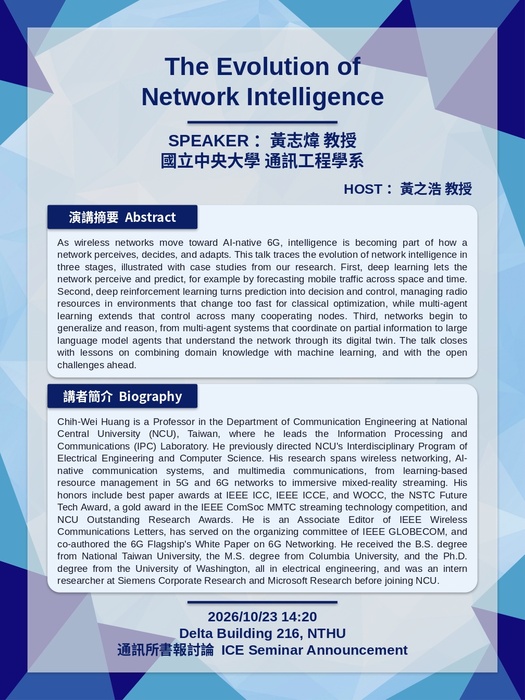
Date & Time:
2026 /10 / 23 (Fri) 14:20 - 16:20
Location:
Delta Building R216, NTHU
Speaker:
黃志煒 教授
國立中央大學 通訊工程學系
Topic:
The Evolution of Network Intelligence
Abstract:
As wireless networks move toward AI-native 6G, intelligence is becoming part of how a network perceives, decides, and adapts. This talk traces the evolution of network intelligence in three stages, illustrated with case studies from our research. First, deep learning lets the network perceive and predict, for example by forecasting mobile traffic across space and time. Second, deep reinforcement learning turns prediction into decision and control, managing radio resources in environments that change too fast for classical optimization, while multi-agent learning extends that control across many cooperating nodes. Third, networks begin to generalize and reason, from multi-agent systems that coordinate on partial information to large language model agents that understand the network through its digital twin. The talk closes with lessons on combining domain knowledge with machine learning, and with the open challenges ahead.
Autobiography:
Chih-Wei Huang is a Professor in the Department of Communication Engineering at National Central University (NCU), Taiwan, where he leads the Information Processing and Communications (IPC) Laboratory. He previously directed NCU's Interdisciplinary Program of Electrical Engineering and Computer Science. His research spans wireless networking, AI-native communication systems, and multimedia communications, from learning-based resource management in 5G and 6G networks to immersive mixed-reality streaming. His honors include best paper awards at IEEE ICC, IEEE ICCE, and WOCC, the NSTC Future Tech Award, a gold award in the IEEE ComSoc MMTC streaming technology competition, and NCU Outstanding Research Awards. He is an Associate Editor of IEEE Wireless Communications Letters, has served on the organizing committee of IEEE GLOBECOM, and co-authored the 6G Flagship's White Paper on 6G Networking. He received the B.S. degree from National Taiwan University, the M.S. degree from Columbia University, and the Ph.D. degree from the University of Washington, all in electrical engineering, and was an intern researcher at Siemens Corporate Research and Microsoft Research before joining NCU.