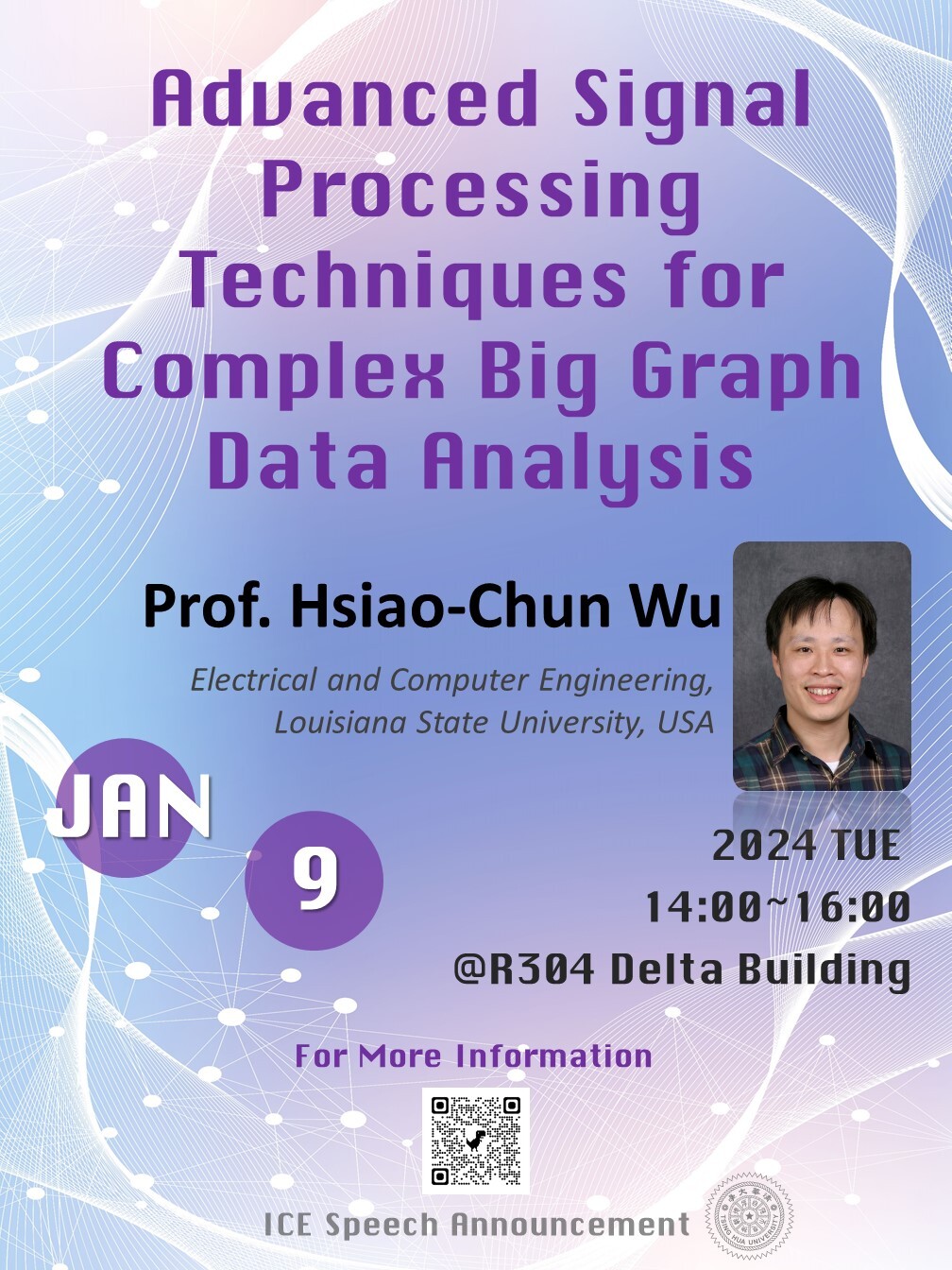
2024/1/9 (Tue.) 14:00 Prof. Hsiao-Chun Wu - Advanced Signal Processing Techniques for Complex Big Graph Data Analysis
演講題目:Advanced Signal Processing Techniques for Complex Big Graph Data Analysis
演講者:Prof. Hsiao-Chun Wu
Electrical and Computer Engineering, Louisiana State University, USA
時 間:14:00~16:00, 2024/1/9 (Tuesday)
地 點:清華大學台達館304室 (Delta Building R304, NTHU)
Abstract
Big complex graph data emerge in many practical applications in signal processing and data analytics nowadays. It is quite challenging to tackle the big complex graph data in research. Two pioneering research projects, namely automatic human-posture recognition and drug-target interaction prediction, involving the cutting-edge signal processing and data analysis techniques for processing high-dimensional graph data will be presented and discussed in this talk. These two projects have a wide variety of applications in intelligent health-care, human-machine interface, indoor human localization and tracking, targeted therapy for cancer treatment, etc.
In the first research project, we utilize the skeletal data, i.e., the three-dimensional-coordinate time-series of twenty-five joints in a human body acquired by Microsoft Kinect sensors for automatic human-posture recognition. In the front end, robust features are extracted through a series of advanced signal-processing algorithms including new dynamic segmentation mechanism and new data-normalization mechanism. In the backend, we have designed two different classifiers. We have exploited a popular deep-learning model, namely Graph Convolutional Network (GCN), to efficiently process the skeletal data, which are actually high-dimensional time-series. A new ablation study related to the selection of "essential joints" is also carried out to further boost the recognition accuracy. On the other hand, we develop a novel signal-processing technique, namely Tensor Regressor, which is a high-dimensional linear model to transform the skeletal data into the posture identification-codes. Note that the difficult real-world problem of identifying human-postures (movements or activities spanning over multiple video-frames of unfixed length) is investigated here. As a result, over seven different common human-postures, the recognition accuracies resulting from the aforementioned two classifiers can reach up to more than 90%.
In the second research project, we explore the bioinformatics inherent in molecules-proteins to predict and analyze drug-target interactions. Ultra-high-dimensional features are extracted from chemical agents (drugs) and proteins as the input. They include (1) Mol2Vec features (molecular structures to vectors) from the chemical agent of interest using a language model, (2) ProtVec features (protein structures to vectors) from the proteins in a human body using a language model, (3) Bionoi-AE features (binding pockets of drug molecules to vectors) extracted from the chemical agent of interest using an autoencoder, and (4) Graph2Vec features (protein-protein-interaction-networks to vectors) extracted from the proteins in a human body using a graph-to-list mapping. Then the collection of the aforementioned four sets of features extracted from the chemical agent (drug) and each protein of interest in a human body will be utilized as a long input feature vector to train a multi-layer percetron (MLP) under the given ground truth (whether the drug will actually interact with the protein or not). The output of this MLP will be binary, i.e., either Yes (drug-target interaction takes place) or No (drug-target interaction does not take place). During the test stage, a new chemical agent (drug) is under development, the new Mol2Vec and Bionoi-AE features will be extracted from this new agent and serve as part of the overall feature vector at the input of the trained MLP. Thus, we can easily predict whether the new drug will interact with the proteins in a human body or not so as to evaluate the effectiveness of this new drug computationally using artificial intelligence. This research project would have a significant impact on personalized medicine by accelerating the drug discovery and targeted therapy.
Both research projects rely on the promising potential of advanced artificial intelligence and high-dimensional signal-processing techniques for handling complex and big graph data. The innovative methodologies we have developed can be applied across many domains, lead to novel solutions to complex big-data related challenges, and serve as the backbone of more and more research breakthroughs in the future.
Biography
Hsiao-Chun Wu graduated from University of Florida in 1999 with a Ph. D. degree in Electrical and Computer Engineering, where he started to dedicate research on Signal Processing under the guidance of Dr. Jose C. Principe. Since March of 1999, he had joined Motorola Personal Communications Sector research labs and gotten involved with the ongoing research for Motorola VR Lite speech recognition software. His research in Motorola included novel robust speech detection and enhancement algorithms in a wide variety of background noise. In January of 2001, he joined the faculty at the Department of Electrical and Computer Engineering, Louisiana State University as a tenure-track assistant professor; he became a tenured associate professor in 2007. In July to August 2007, Dr. Wu was a visiting assistant professor at Television and Networks Transmission Group, Communications Research Centre, Ottawa, Canada. From August to December 2008, he was a visiting associate professor at Department of Electrical Engineering, Stanford University, California, USA. His current interests are in graph-based algorithms, topological analysis, finite-field transforms, audio/speech signal processing, image processing, neural-networks/artificial-intelligence, pattern recognition and machine learning, wireless systems, wireless communications, intelligent systems, robotic technologies, indoor and outdoor localization/ranging/navigation mechanisms, non-destructive evaluation for material, civil, and mechanical structures, and biometric instrumentation. Dr. Wu has published more than 300 refereed journal and conference papers in signal processing, broadcasting, wireless communications, computer, electronics, sensor networks, and ultrasonics areas (more than 260 of them are published by IEEE or ACM). He has ever served on twenty journal editorial boards in the area of electrical and computer engineering including IEEE Transactions on Signal Processing, IEEE Transactions on Communications, IEEE Transactions on Mobile Computing, IEEE Transactions on Wireless Communications, IEEE Transactions on Broadcasting, IEEE Transactions on Vehicular Technology, IEEE Communications Magazine, IEEE Communications Letters, IEEE Signal Processing Letters, etc. From 2009 to 2011, he has been serving on IEEE Multimedia Technical Committee. Dr. Wu is currently an IEEE Distinguished Lecturer and an IEEE Fellow of Class 2015.